By J. Scott Orr
The latest fashion venture from actor and humanitarian Angelina Jolie made its Lower East Side debut on Dec. 4. Early reviews are mixed.
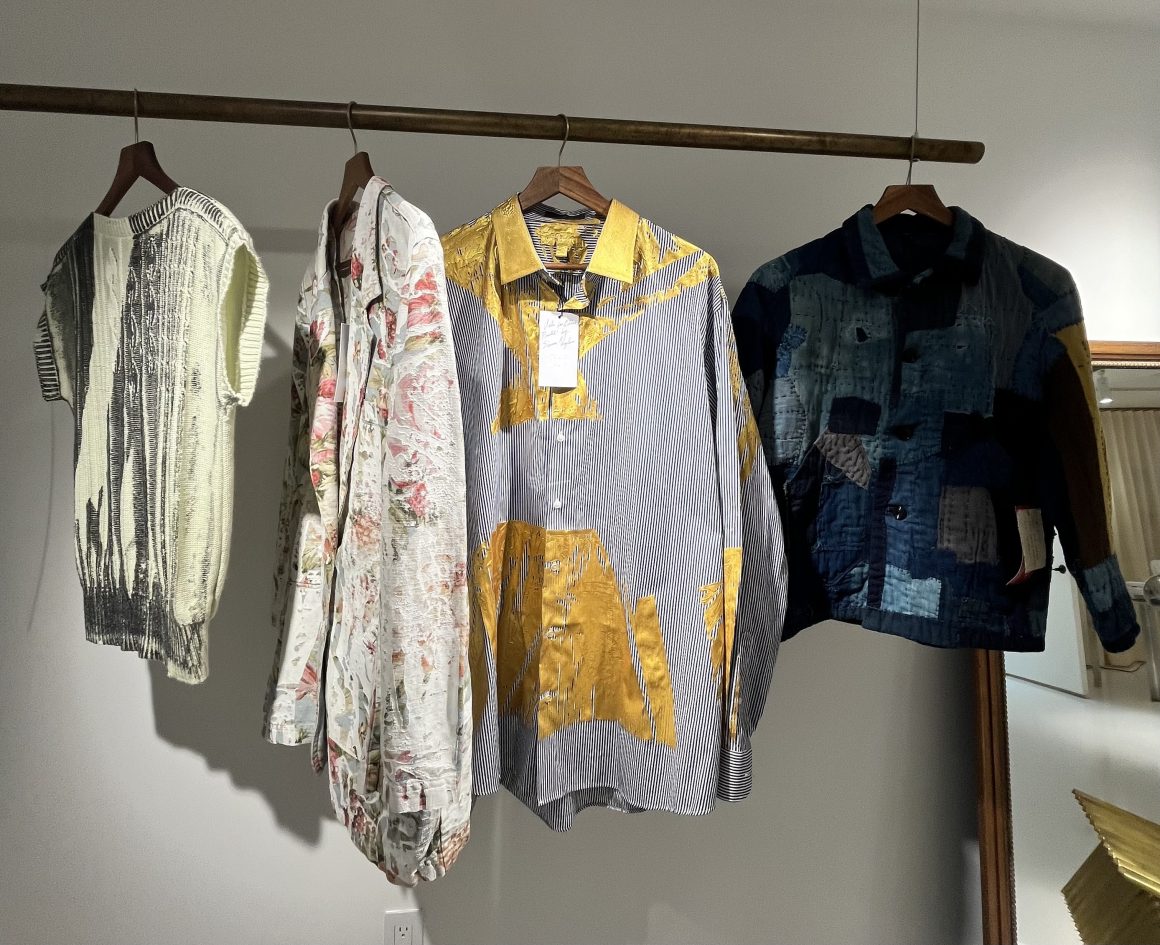
Investing some $60,000 per month in rent, and more in renovation costs, Jolie has opened Atelier Jolie in the two-story Civil War-era building at 57 Great Jones Street where neo-expressionist giant Jean-Michel Basquiat lived, worked and died. An artsy establishment where custom t-shirts are made, espresso is served, and high-fashion articles carry price tags with commas in them, Atelier Jolie is hardly the ramshackle art studio and party space Basquiat made a neighborhood landmark in the 1980s. Still, it’s not a Starbucks.
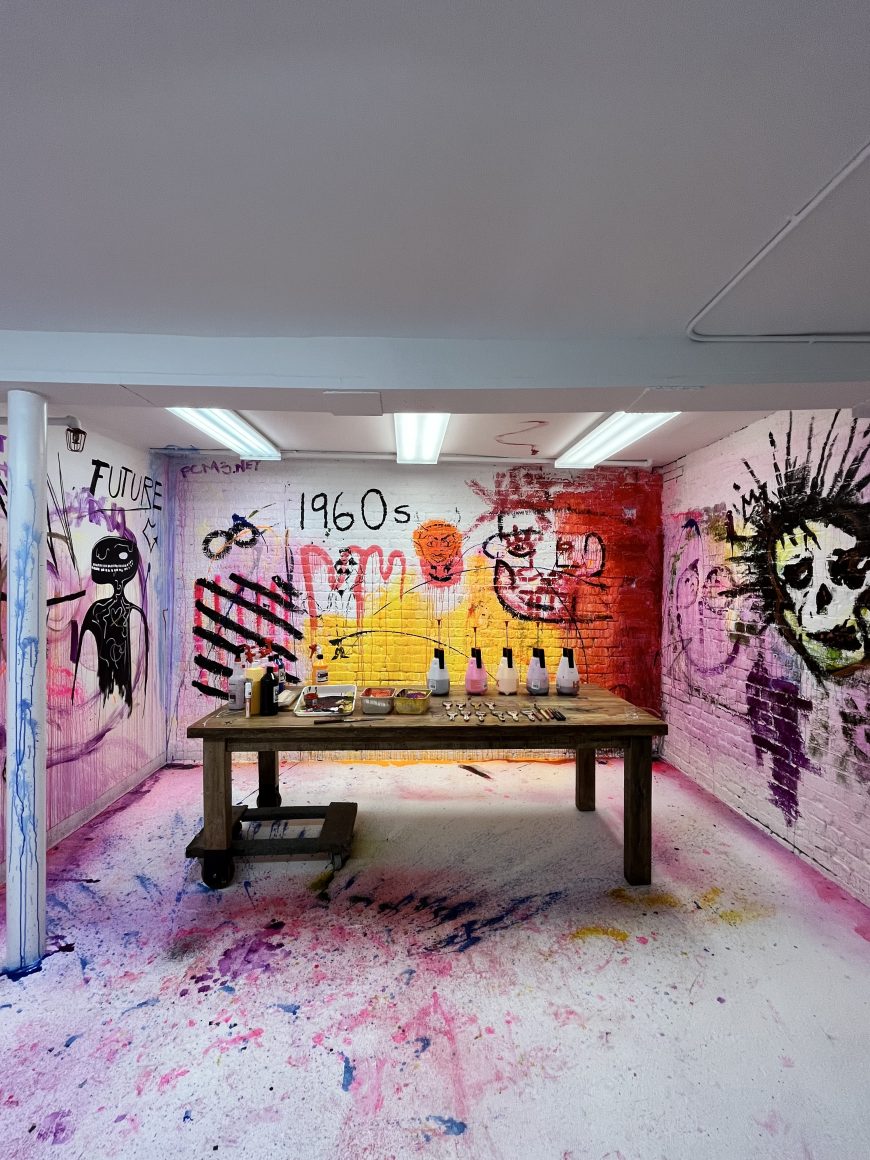
For those who knew Basquiat, whose works have brought modern-day price tags in excess of $100 million, the use of the space for a commercial venture is a bit disappointing. At the same time, though, they agreed that it could be worse. They noted that Jolie is an artist herself, recognizes Basquiat’s importance as a downtown icon of historic proportions and seems committed to maintaining his Great Jones Street legacy. For the time being at least, she is allowing the ever-evolving graffiti tributes to Basquiat to remain on the building’s exterior, and there are reminders of the late artist inside as well.

Largely redone in white-cube fashion, the space’s main floor features two walls splashed with an assortment of graffiti tags, including a couple by SAMO©, the graffiti writing duo Basquait formed in the late 1970s with schoolmate and friend Al Diaz. Seemingly preserved in fealty to Basquiat’s fulsome legacy, one of the tags says “SAMO© as Viagra 4 a flaccid society…” To be fair, there is no suggestion that the work was committed by Basquiat himself, but neither is there a clear assertion that it wasn’t. And it wasn’t, obviously, since Viagra did not hit the market until 1998, a decade after a drug overdose claimed Basquiat’s life at age 27.
At the same time, though, the SAMO© tag is not a total fraud. It was done by Diaz as part of a show of his latter-day art that took place in the space in 2018. So the tag, like the entire Atelier Jolie project, is real, but at the same time, it’s not completely authentic, sort of a Schrödinger’s cat situation. And that does tend to track with the paradoxical feelings expressed by a lot of people about the emergence of Atelier Jolie at 57 Great Jones Street.

In a series of interviews with a host of Basquiat intimates, including Diaz, an early live-in girlfriend, his first gallerist and assorted friends and acquaintances, the reactions were nearly identical: It’s not the sweeping homage to one of the 20th century’s most important artists that it could be, but neither is it a Starbucks.
Diaz, who lunched with Jolie recently at the toney Il Buco Alimentari & Vineria at 53 Great Jones Street, said he explained the provenance of the SAMO© graffiti in the space to the actor. He’s not sure how much of what he said sank in.
“She was nice enough. They discovered the graffiti and wanted to know the backstory. They got in touch with me….It’s cool that they preserved the graffiti. I gave the assistant and Angelina a fairly clear explanation,” Diaz said.
More than 40 years since the last binary SAMO© tag was deployed, Diaz is at once disgusted and amused by the way the Basquiat story has been distorted over the years, including some details about the famous Great Jones Street address.
“Andy Warhol bought the building and there were all kinds of false stories that circulated about it. There was one story that he and Warhol lived there, which of course was complete horse shit. I don’t know what Jean-Michel would think about what’s going on there now, he probably couldn’t care less,” Diaz said.
The building is one of the neighborhood’s most historic structures. Built as a stable in the 1860s, it was taken over in the early 20th Century by mobster Paul Kelly, who led the infamous Five Points Gang. In 1970, it was bought by Warhol who leased it to Basquiat, who lived and worked there from 1983 until his death in 1988.
Since then, it has drawn generations of Basquiat fans seeking to embrace his legacy. Among them were legions of graffiti artists who have been leaving their marks on the building for decades. Every once in a while someone paints it over, only to have it re-tagged within days. To her credit, Jolie appears content to leave the outside to the spray paint, wheat paste and sticker set.
Noted portrait photographer Richard Corman, who created the last great portraits of Basquiat in the space on assignment for L’uomo Vogue, in 1984, said 57 Great Jones was a refuge for the artist, a place where he could summon a gentle, reflective cool even when it was crowded with people. Corman described Basquiat as “someone who was angry, a certain sadness, but there was tremendous charisma and youth. He was incredibly present and engaging in this very quiet way.” Does Corman believe the building should be used to sell high fashion?

“I have mixed feelings about it. Should it be an homage to Basquiat? Should there be imagery? It sat there for a while, so it could have been anything. And Angelina’s an artist so…it’s not a Chase Bank,” he said.
Alexis Adler, who lived with Basquiat on East 12th Street during 1979-80, said it’s a tough question. “I know that a lot of people would like to be associated with that name and the artist and I can’t pass any judgment one way or another, certainly. I’m glad it’s being used, but it could also be used as a museum. There are a lot of uses for a historic building like that.”
“On the other hand, it’s still associated with him and the art he made there. It could be like a McDonalds or something like that that would have no association with him. Hopefully she (Jolie) understands that she’s in this important space and maybe it will pay homage to him in some way,” Adler said.
Art historian and Basquiat scholar Dieter Buchhart went a little further, suggesting that there are far better ways to protect Basquiat’s legacy than turning his last home/studio into a high-fashion boutique.
“I feel it could be a little sad story. Honestly, Basquiat is such an important artist. I would call him one of the 10 most important artists in art history at the moment. I think we should take care of the studio…..I mean, there have been much less important artists given museums … This space, this Great Jones Street is the one connection with the city, with Warhol, with everything. I think that should be really respected,” he said.
Eric Justin Johnson, a long-time friend of Basquiat who witnessed his rise to fame and ultimate demise, said it’s one thing to try and create an appropriate tribute to an artist of Basquiat’s stature, but another to get it right.
“Most people who knew Jean well are probably thinking he’d be turning in his grave about the way his legacy and his estate have been handled. There is this over-marketing of his license, image and legacy that’s going on there. The jury is out on what Jean would have thought of it. So many people understand and want to honor his legacy, but they may or may not get it. They may not get what he and his art were all about,” he said.

Patti Astor, who ran Fun Gallery, the East Village space where Basquiat, Keith Haring and other greats of the era were shown, wondered what Basquiat would think of Atelier Jolie and the countless other appropriations of his legacy.
“He would hate a lot of what’s being done: they’re making door mats. I don’t know how much Angelia Jolie knows about that time and place or if she even really knows him. I guess it’s just a poignant reminder that, like everything else from that era, Great Jones Street is gone. We’re gonna have to accept the past is the past. We want to remember the past and we need to keep these visions alive. I don’t feel a need to give Angelina Jolie any amount of thought. I’m sure that everyone would like to see a tribute to him, but who knows what that’s gonna look like. I’ll kind of just wait and see,” she said.
J. Scott Orr is a career writer, editor and a recovering political journalist. He writes about art for UP Magazine, Whitehot Magazine, Art511 and other outlets. He is publisher of the East Village art magazine B Scene Zine. You can find him on Instagram here.