Happy Clothes: A Film About Patricia Field, just wrapped up a successful world premiere with screenings at the Tribeca Festival. Patricia Field might be best known for styling the clothing on Sex and the City, The Devil Wears Prada and Ugly Betty, but locally, she’s known for her beloved downtown apparel shop on 8th Street, which then moved to the Bowery. It was a cultural hotspot that welcomed creatives, socialites, divas and rebels alike, for almost 50 years. Field also lives in the neighborhood and has been in the area for decades.
The documentary is an endearing look at Field’s long career and it delves into her own creative process, which is still running strong after so many years. It includes interviews with big names like Sarah Jessica Parker and Kim Cattrall, from Sex and the City, show creator Darren Star, Lily Collins (Emily in Paris) and Michael Urie (Ugly Betty) who have all clearly enjoyed working with Field.
The film is a hoot, in large part because Field’s authentic New York personality comes shining through. It covers Field’s vast career as a stylist and designer running her own shop downtown, as well as working in film and television since the ’60’s. Field was born here, and grew up in Queens, after her parents immigrated from Armenia and Greece.
We spoke with director Michael Selditch about the process of making the documentary and got some of his takeaways after working with the iconic costume designer.
Initially, Selditch said, Field turned him down when he proposed the project to her. But after about a year, and as the pandemic progressed, he went back and asked again. This time he was focused on learning about her process and seeing it in action, and she said “yes.”
“I wanted to watch her work, to see her process. That was my main interest,” he said. “I knew there were going to be moments of history to tell, but I didn’t want the whole film to be the traditional interview/archival documentary that we see all the time…That kind of thing can be made fifty years from now, when she’s gone. But here she was, working on two TV shows and writing a book, [Field just turned 81] so I knew right away that those would be three stories that I followed and told. And I wanted to see, especially a fitting. How does she get to this, (what some people think is a crazy outfit) how does that happen? It doesn’t just happen by saying ‘put this on.’ I knew there was a process to it, so that’s what I really wanted to see.”
The actors in the film clearly seem to have fallen in love with Field and speak admiringly of working with her.
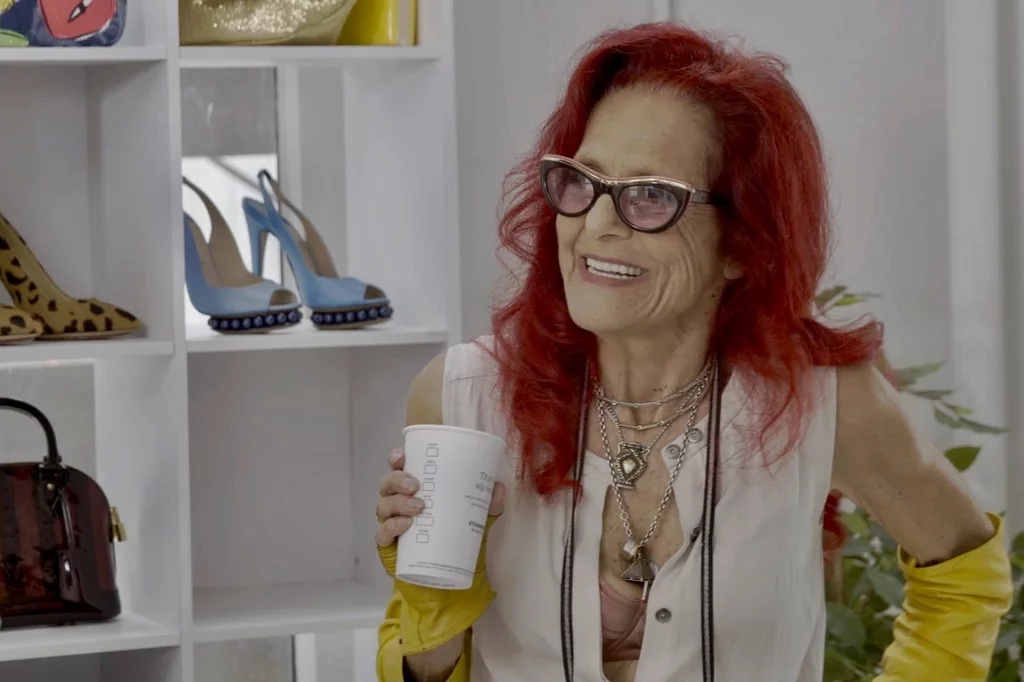
Selditch said, “That was an interesting thing that I found out about her during this – you know being a filmmaker, I’ve been through this process and have worked with actors before, but I never really thought of the idea of a costume designer doing anything but looking at the script and figuring out who the character is. But Pat takes it in a whole different direction: she looks at the script, she figures out who the character is and then she looks at the actor playing the character and she combines the two. She said to me at one point — it’s not in the doc — but she said, ‘you know if Carrie Bradshaw [from Sex in the City] had been played by a different actress, she probably would have looked different.’ So it was very much about who Sarah Jessica Parker was and who this character was and how [Parker] approached that character. I think that’s a fascinating and wonderful way of working, and I don’t believe [many] other costume designers approach it that way. I think they just look at the character on the page, and that’s who they’re dressing. It could be interchangable, whoever’s playing that role.”
Selditch said he thinks that is one of the many things that makes her stand out among her peers.
It’s also clear in the film that she’s inspired by the human element of it all. She offers encouragement to the actors she works with and designs in ways that offer function as well as fun, giving them confidence to work with their roles. When asked to define her style on camera, she declares, “I don’t know. It’s just happy. I like happy clothes because I’m a happy person.”
We get to see Field in action in the documentary, while she’s working on the Starz show, Run the World. There is a segment that covers a fitting with one of the stars, Bresha Webb.
As far as collaboration, Selditch said, “it’s all about trust. And I felt like even I had to gain Pat’s trust. Because she didn’t know me before we started working, and once I felt like I gained her trust, it was smoother going forward.”
“It makes her uncomfortable when people put attention on her,” he said. She told him she doesn’t like it when people put her on a pedestal.”
The archival footage from her shop used in the film is a treasure trove of downtown history. It’s a who’s who of now famous people, who worked and hung out there before making names for themselves.
“That was the hardest part of the doc for us,” Selditch said. “That was the part we edited the most — that ten-minute section that goes into the history of her store. Many times my editor and I would say to each other, ‘you could do a whole documentary just on her store.’ There’s a lot of stuff there, so to figure out what to lose (to cut) was the challenge.”
Field’s store was a real landmark of the downtown scene.
Selditch said, “I moved to New York in the late ’80s and I used to go to her shop then, and in the early ’90s, and I just felt it was so important for somebody to document this. For people to see – a lot of people who know her work from Sex in the City, don’t live in New York and weren’t familiar with her store. For a person, a woman, a first generation American, an openly gay woman to have a successful store, that was opened in the ’60s that lasted for 50 years – how many people can say they’ve done that in NYC, against all odds?”
The film will continue its festival tour, both internationally and nationally, for the next few months. Hopefully, it will be coming to a theater near you, soon.