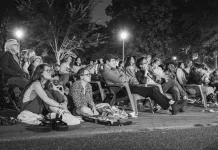
It was standing room only last night at University Settlement, where angry residents descended on Community Board 3’s transportation committee to fight Greyhound/Peter Pan’s proposal to establish a new bus stop on Essex Street in front of Seward Park. When it was all over, the committee voted unanimously (5-0) to tell the city’s Transportation Department to find another spot for the stop, which would facilitate 16 arrivals and departures daily between New York and Philadelphia. It remains to be seen how the DOT will respond. No representative from the transportation agency was present last night.
In the past two weeks, outraged residents mobilized to oppose the plan to create the stop across from 3 Essex Street in front of the playground at Seward Park (at Canal Street). They submitted letters, postcards and an online petition (with more than 1100 signatures). More important, they came in large numbers to last night’s meeting to testify against a proposal they argued could destroy the fabric of the neighborhood. It was one of the largest crowds assembled for a CB3 public hearing in many months.

David Crane, transportation committee chair, struggled to control the proceedings, as some attendees taunted the community board for allegedly “having no backbone” and for refusing to “stand up to the city.” He explained that CB3 had been pushing the city and elected officials for several years to regulate the rapidly expanding Chinatown bus industry. Legislation, signed by Governor Cuomo last month, establishes a permit system and requires buses to load and unload passengers in designated spaces, rather than stopping wherever they choose.
The system, he argued, would (when fully implemented several months from now) address community concerns about street and sidewalk congestion, pollution and loitering. The Greyhound/Peter Pan application is an early test for the DOT; the new law requires consultations with local community boards. Crane emphasized that the community could only push the city so far given its limited influence in the process. He also pointed out that federal law prohibits the city from banning private bus operators. It’s not a question of whether there are bus stops on Manhattan’s streets, he said, but where they are located.

Linda Jones, a leader of Friends of Seward Park and a CB3 member, acknowledged that some people see the fight against the Essex Street bus stop as classic “NIMBY” (Not in My Backyard) behavior. Saying she supports the new law, Jones added that the proposed location is a problem (not simply because she lives nearby) but because “my back yard is the beautiful, historic Seward Park… (which is) defined by the Parks Department as a playground.”
Rima Strauss, a resident of The Forward Building, said she cherishes her days in Seward Park taking part in Chinese dance and worries that the “gentle character of the neighborhood is threatened” by Greyhound’s proposal. “I don’t trust them,” Strauss asserted, suggesting that the company’s concessions to the community (cutting daily pickups/drop-offs in half) could simply be a temporary ploy to win approval and to gain access to the Chinatown marketplace. She said supporting the application amounted to a vote against “families, kids, the elderly and the Chinese community.”
A resident of 48 Canal Street said his negative experiences with other bus operators give him no confidence that Greyhound will be able to manage its proposed street-side operation. He said a 2-year old had been abandoned in the lobby of his building and a brick came sailing through the window. Another speaker suggested the company had made a callous decision to establish the bus stop in an area filled with low income residents because it had “made a value judgment that kids (in this neighborhood) don’t count.” In written testimony, Bob Zuckerman of the LES Business Improvement District wrote, “this particular location in our view is not well-suited for this type of activity… the proximity… to Seward Park and the adjoining playground presents serious concerns that must be addressed…”
Several officials were on hand last night representing Greyhound and Peter Pan. Christian DiPalermo of TLM Associates (a consulting firm hired by the companies) did most of the talking. The new service created to serve Chinatown will be called “YO! Bus.” There will be a ticket office on East Broadway, a couple of blocks away from the bus stop. During layover periods, the buses will park in the city-owned lot at Montgomery Street, on the East River (the future home of the Pier 42 park).
DiPalermo said the buses will all use “ultra-low sulfer diesel fuel.” Uniformed staff will be available to deal with sidewalk congestion. Only ticketed passengers will be allowed to wait on Essex Street. And “YO!” staff will make sure garbage is picked up, he said. DiPalerno said the company had demonstrated a willingness to work with the community, as evidenced by its decision to reduce daily trips from 28 to 16. Average ticket prices will be $12-15. A colorful pamphlet passed out during the meeting explained:
Chinatown has had a recent influx of unsafe, unidentifiable, discount bus lines that operate without regulation or oversight. In May 2012, the Federal Motor Coach safety Administration shut down 26 Chinatown discount bus carriers for safety violations… Greyhound and Peter Pan two of the safest, most recognized motor coach operators in the nation, have designed YO! Bus, a specialty targeted intercity bus service to directly serve the residents, students and workers of Chinatown by offering safe, reliable and affordable non-stop service between New York and Philadelphia.
In spite of the coordinated PR offensive, many residents were unconvinced Greyhound is sincere in its efforts to collaborate with the community. DiPalermo was heckled by some members of the audience when he declined to disclose two alternate bus stop locations the company had proposed to the Transportation Department. After CB3 member MyPhuong Chung criticized the applicants for failing to answer the committee’s questions, Greyhound finally came forward with details about the other locations. One stop, the officials said, would have been located at 62 Allen Street, but the city rejected the suggestion because it’s already a Select Bus Service stop. The other location was 3 Pike Street, where the city apparently plans to install a BikeShare terminal.

At one point, Committee Chair David Crane wanted to know whether the company would be willing to ask the DOT to delay the application. DiPalermo responded, “Not at this time… we will let the process unfold.” In a separate exchange, CB3 District Manager Susan Stetzer asked whether Greyhound would agree to pay for an air quality study on Essex Street. DiPalermo deferred to the DOT, saying it was their call.
Throughout the evening, members of the audience pushed the community board to send an unequivocal message to the DOT expressing strong opposition to the bus stop proposal. Crane voiced concern that an uncompromising statement could have unintended consequences. The community board typically embeds “stipulations” in its resolutions, detailing certain restrictions it would like to see the DOT impose on operators. In a separate resolution last night for an already existing bus stop at 55 Chrystie Street, for example, the committee asked the operator to continue using an indoor waiting area for passengers and to create a regimented boarding system. If CB3 rejected the Essex Street location, Crane suggested, the city might very well establish the bus stop without any restrictions protecting the surrounding community.
One speaker did make a forceful case in support of the Chinatown intercity bus industry. Wellington Chen, head of the Chinatown Partnership, said businesses have been hit hard by the federal crackdown on independent operators. “Do not cut our lifeline,” he urged. On the 11th anniversary of 9/11, he noted that Chinatown has never fully recovered from the terror attacks and even went so far as to say, “don’t let bin Laden win.”
But in the end, the committee decided (with considerable goading from the crowd) to send an unambiguous message to the DOT. The resolution it approved stated that the community board objects to the Essex Street bus stop proposal and asked the Transportation Department to suggest alternate locations. The draft resolution will be sent to the city before the full board vote later this month since the DOT is coming up on the end of a 45-day comment period.
DOT community liaisons very often attend transportation committee meetings but they took a pass last night. CB3 District Manager Susan Stetzer said she invited them on two separate occasions but they declined, saying it was up to Greyhound to make its pitch to the community before the agency weighs in.
Following the meeting, DiPalermo told The Lo-Down that the companies feel Chinatown is plagued by illegal operators and that the “YO!” proposal would offer a safe, clean alternative in the neighborhood. He said the company plans to be in Chinatown for a long time and is committed to serving the community. The initial permit would be for six months, beginning in April.